ai-hedge-fund-crypto
AI-Hedge-Fund for Crypto 🚀 AI-powered hedge fund for cryptocurrency trading, leveraging LLM agents for intelligent decision-making.
System Structure
저장소별 전략/실행 조건 확인 필요
백테스트/분석 결과를 바탕으로 수동 판단
Editor Summary저장소 설명과 공개 메타데이터 기준으로 AI/LLM 또는 머신러닝 활용, Python 기반 구현, 암호화폐 거래 봇, 거래소 API/프레임워크 성격의 프로젝트로 파악했습니다. 확인 근거는 README, 저장소 토픽, 저장소 설명, GitHub 지표, 파이프라인 필드이며, 주요 데이터는 암호화폐 거래소 시장 데이터, 가격/거래량 데이터입니다. 전략/실행 조건은 저장소별 문서와 코드 확인이 필요하며, 실행 방식은 "백테스트/분석 결과를 바탕으로 수동 판단"라고 보수적으로 기록했습니다. GitHub 지표는 별 598개, 포크 153개입니다.
| Repository | 51bitquant/ai-hedge-fund-crypto |
|---|---|
| Creator | 51bitquant |
| Stars / Forks | ★ 598 / 153 |
| License | MIT |
| Last Updated | 2025-09-05 |
| Snapshot Date | 2026-07-08 (README below is a copy from this date) |
This is third-party open-source code. QuantField does not guarantee its behavior or safety. Review the code before installing or running it.
README
AI Hedge Fund Crypto


A next-generation algorithmic trading framework that leverages graph-based workflow architecture, ensemble technical analysis, and AI language models to make data-driven cryptocurrency trading decisions. This system employs a directed acyclic graph (DAG) of specialized nodes for multi-timeframe analysis, enabling sophisticated signal generation through weighted combinations of diverse trading strategies.
At its core, the system builds upon LangGraph's computational graph architecture to process market data through a pipeline of technical analysis nodes. Each strategy implements a BaseNode interface that processes multi-interval data for multiple assets simultaneously. The framework then aggregates these signals using adaptive weighting mechanisms, evaluates risk parameters, and formulates position management decisions through large language model (LLM) analysis.
The system stands out through its:
- AI-Enhanced Decision Making: Integration of large language models (LLMs) for portfolio management decisions, combining technical signals with sophisticated reasoning
- Compositional Architecture: Distinct nodes for data fetching, strategy execution, risk management, and portfolio management
- Signal Ensemble Approach: Weighted aggregation of multiple technical strategies (trend following, mean reversion, momentum, volatility, and statistical arbitrage)
- Multi-Timeframe Analysis: Simultaneous processing across various time intervals for more robust signal generation
- Dynamic Strategy Visualization: Automatic generation of computational graph visualizations to better understand the decision flow
- Comprehensive Backtesting: Robust historical performance evaluation with detailed metrics and visualizations
Backtest Results
Sample backtesting results showcasing how well-designed trading strategies can generate high-quality signals when implemented in this framework. The system's performance is driven by the quality of your strategies, with the framework enabling efficient implementation, LLM-based decision refinement, and multi-timeframe analysis:
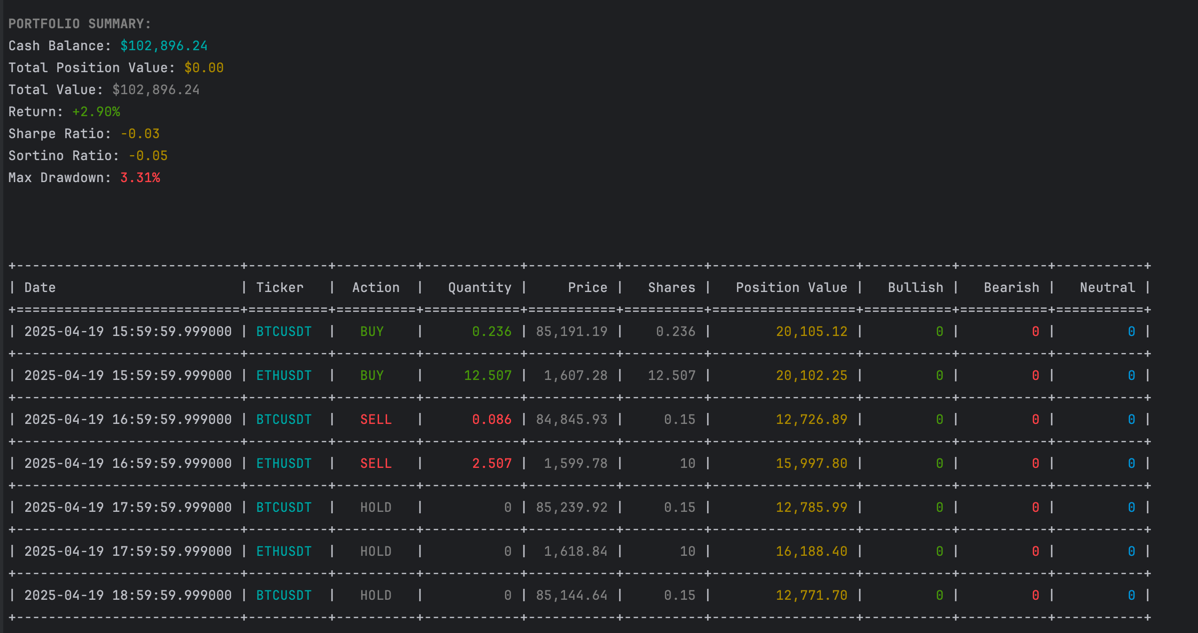
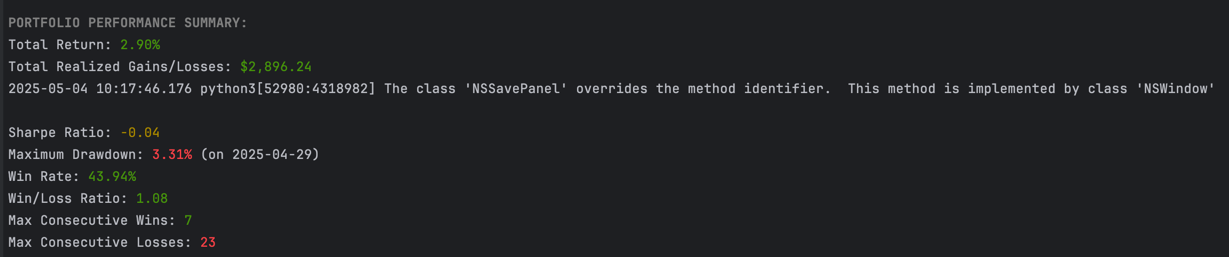
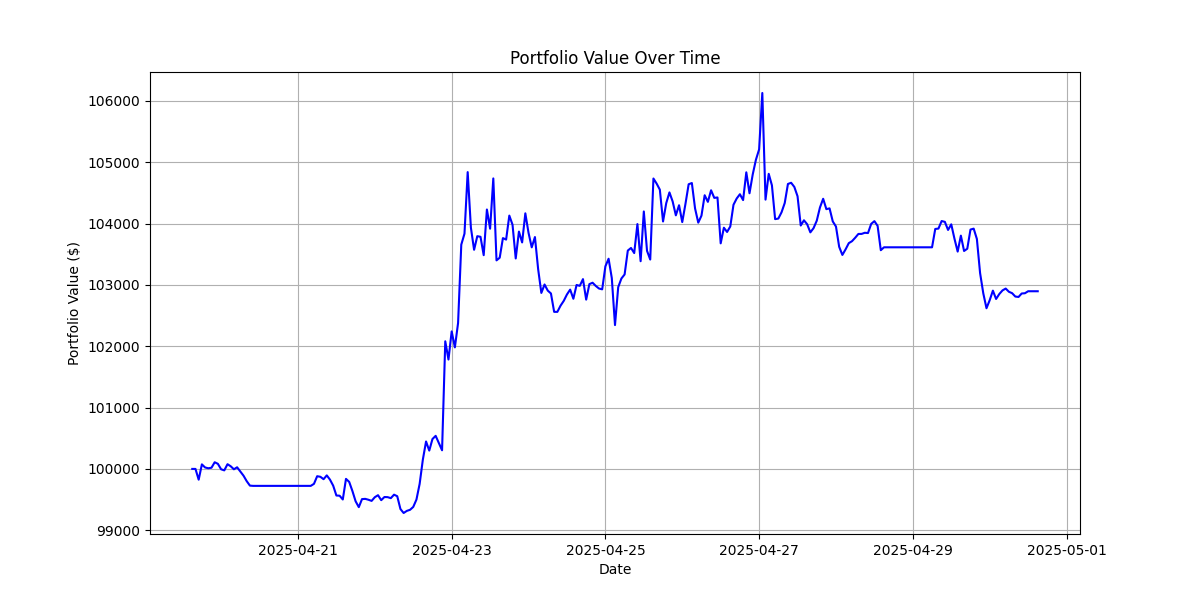
These results demonstrate the system's ability to:
- Generate profitable trading signals across different market conditions
- Manage risk effectively with position sizing rules
- Adapt to changing market dynamics with multi-timeframe analysis
- Provide detailed performance metrics for strategy evaluation
Architecture
The system is built around a highly configurable directed acyclic graph (DAG) architecture, where data flows through various processing nodes. This architecture provides exceptional flexibility, allowing users to customize both the available strategies and the timeframes for analysis without modifying the core code.
Node-Based Workflow System
At its heart, the system uses LangGraph to create a dynamic computational graph where:
- Start Node: Initializes the workflow and prepares the state for processing
- Data Nodes: Process market data for specific intervals (e.g., 30m, 1h, 4h)
- Strategy Nodes: Apply technical analysis algorithms to the processed data
- Risk Management Node: Evaluates position limits and exposure
- **Portfolio Man